
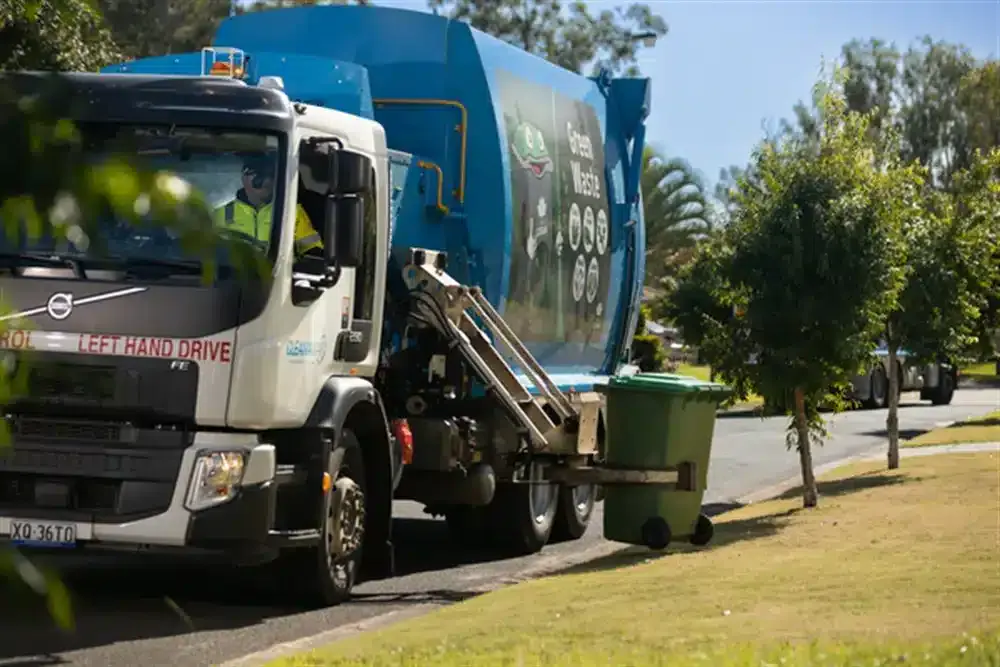
Waste Management Plans are often treated as a documentation requirement, but in practice, they can directly affect site layout, vehicle access and development feasibility.
For development applications (DAs) in South East Queensland, a Waste Management Plan must demonstrate that waste storage, collection, access, and servicing arrangements are workable in practice.
Where this is not clearly resolved, waste-related issues can become a source of council information requests (RFIs) and design revisions during assessment.
Why Waste Management Plans Matter at DA Stage
Councils assess Waste Management Plans because waste collection is an operational function with direct design consequences.
It affects service vehicle access, pedestrian movement, internal circulation, and the public realm simultaneously.
Where waste planning is not resolved early, the issues are usually practical rather than theoretical.
Waste trucks may not be able to access the site efficiently; bins may need to move through pedestrian areas; and collection points may conflict with entries, loading zones, or circulation routes.
These are the types of issues that often surface during assessment and lead to RFIs or redesign.
What Councils Assess in a Waste Management Plan
While requirements vary across South East Queensland councils, assessment typically comes back to four core areas: waste generation, storage design, collection vehicle access and transfer to the collection point.
Different land uses generate different waste volumes, so developments need sufficient storage capacity between collections.
Storage areas must be accessible to occupants and workable for collection contractors; poor bin room design is one of the most common causes of operational issues after occupancy.
Collection vehicle access is usually the most technical component. Waste trucks require adequate driveway width, turning space, height clearance and servicing area. If these cannot be achieved safely, the collection method may need to change.
Councils also assess how waste moves from storage to collection. Whether waste is managed entirely on site or relies on kerbside collection, each approach carries different operational and safety implications.
Why Waste Truck Access Often Drives the Design
For many developments, the most complex aspect of a Waste Management Plan is demonstrating that the collection vehicle can access and service the site safely.
Waste trucks have large turning paths and limited manoeuvrability compared with passenger vehicles. On constrained sites, particularly those with basements, narrow driveways, or tight internal layouts, access design often needs to be carefully coordinated with the architectural layout.
Where trucks are expected to enter the site, access routes and servicing areas typically need to be verified using swept path analysis to confirm that movements can occur without conflict. In practice, this is often where waste planning intersects with broader traffic engineering considerations such as service access, loading arrangements and internal circulation.
Common Issues Identified During Assessment
Waste Management Plans are frequently revised during the development application process, not because waste planning was ignored, but because operational constraints only become clear once the layout is properly tested.
In our experience, the most common triggers include:
- lack of evidence that vehicle movements have been tested
- waste trucks unable to safely enter, turn or exit the site
- collection areas conflicting with access points or internal circulation
- insufficient space for storage or servicing
- reliance on servicing arrangements that are difficult to operate in practice
These issues are typically far easier to resolve during design development than after lodgement, when changes can begin to affect the broader layout.
Why Traffic Engineering Input Is Often Required
Waste Management Plans are sometimes treated as an operational exercise, but for many developments, they are also a traffic and servicing problem.
Waste trucks use the same access points, internal roads and loading areas as other service vehicles. Their size and turning behaviour mean that driveway geometry, swept path envelopes, ramp design and interaction with pedestrian and vehicle circulation all need to be considered together.
For developments in Brisbane and South East Queensland, this is why Waste Management Plans are often supported by traffic engineering input.
Where servicing access or circulation is constrained, input from a traffic engineer in Brisbane, QLD, can help confirm that collection arrangements are workable and compliant.
Integrated Waste and Traffic Planning in Practice
Waste planning often overlaps with traffic engineering, particularly on constrained or higher-density developments where service vehicle access, refuse storage, and internal circulation need to operate together.
Modus regularly works across both disciplines at the development application stage to resolve these issues early, before they become layout constraints later in design.
On the West End Towers development in Brisbane, this approach was used to coordinate servicing access, vehicle movement and site circulation within a constrained urban environment.
Early consideration of these factors helped inform the project’s traffic engineering strategy and supported a workable servicing arrangement at DA stage.
The coordinated approach informed the project’s Traffic Impact Assessment, Swept Path Analysis and Waste Management Plan, helping shape a site-specific servicing and waste strategy for the proposed development.
Need Help Preparing a Waste Management Plan?
Reviewing a Waste Management Plan or responding to a council RFI?
Early assessment of waste storage, servicing access and collection arrangements can help identify constraints before they lead to redesign or delays.
Modus prepares Waste Management Plans for development applications across Queensland, including Brisbane.
Where required, our team integrates traffic engineering input and swept path analysis to ensure collection arrangements are practical and compliant.
Fill out this quick form, and an engineer will be in contact to assist you shortly!
Or give us a call on: 1300 606 408
Disclaimer: The information provided on this page is general in nature and does not constitute site-specific engineering advice. Traffic management requirements vary depending on individual site conditions, operational characteristics, and regulatory obligations. A detailed assessment by a qualified professional is required to determine appropriate traffic management measures for any specific location.
