

When an incident occurs on a routine job, the investigation goes beyond that job. Here is how councils close the gap before that happens.
When something goes wrong on a routine maintenance job, investigators can ask whether the right process was followed. Whether the correct Traffic Guidance Scheme was selected. Whether it was documented. Many councils struggle to answer those questions consistently.
Pothole repairs, verge works, drainage maintenance and vegetation trimming are familiar activities. They are repeated daily across the road network by experienced crews. That familiarity is an asset, but it can also be the point where risk stops being actively managed. When crews have run the same job a hundred times, the pre-start assessment can quietly become a formality. And when something goes wrong on job 101, what the council can demonstrate about its process across similar works becomes highly relevant.
A standardised Traffic Guidance Scheme framework addresses this directly. It does not remove judgment from the worksite. It gives that judgement a repeatable structure, one that supports consistent decisions, consistent documentation, and an auditable record across the full program of works.
Why council maintenance programs produce inconsistent traffic management
Maintenance programs rarely fail because crews do not understand traffic management. They become inconsistent because there is no single reference point for how a standard decision should be made.
One crew selects a Traffic Guidance Scheme that another crew would not have chosen for the same work type and road environment. Comparable sites are treated differently. Internal review is repeated on work that has an identical risk profile to work approved last month. None of these decisions are necessarily wrong. But over time, the cumulative pattern becomes harder to account for.
For Australian councils operating across varied road environments, including residential streets, rural roads, town centres, school zones and higher-speed approaches, the range of conditions that field crews encounter makes this worse. Without a framework that defines when a standard arrangement applies and when it does not, individual judgment fills the gap. Sometimes well. Sometimes not. Always inconsistently.
How a Traffic Guidance Scheme (TGS) framework works for council maintenance
A Traffic Guidance Scheme (TGS) shows the layout of signs, devices and traffic control measures for a defined work scenario. A Traffic Management Plan sets out the broader risk management context, covering responsibilities, procedures, escalation, communication and implementation.
For routine council maintenance works, these two things work together. A standardised Traffic Management Plan defines the program-level approach. A suite of Traffic Guidance Schemes gives crews the specific arrangements for defined activities and site conditions. The framework connects them with a pre-start assessment process and clear escalation criteria.
The result is not a folder of drawings that crews select arbitrarily.
It is a decision structure.
A worker or supervisor identifies the work type, compares the site conditions against the scenario assumptions, confirms whether the standard arrangement applies, and if it does not, knows exactly what to do next.
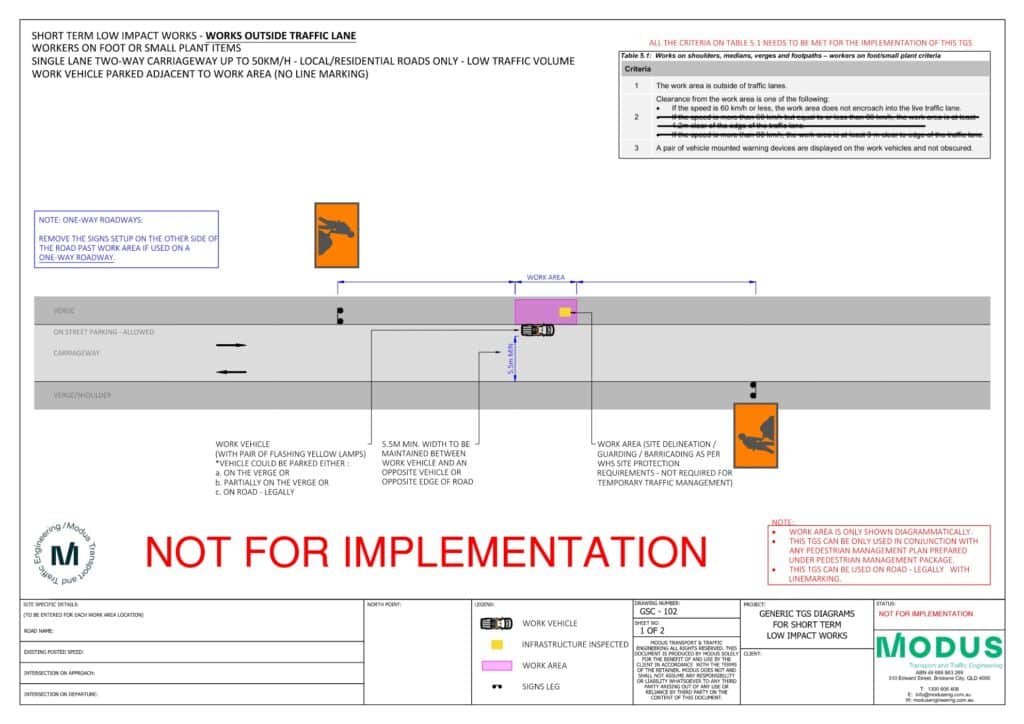
The Austroads Guide to Temporary Traffic Management recognises that standard arrangements must be used only where their assumptions and conditions are met. A well-designed framework makes that boundary explicit, not implied.
Which routine council works can use standardised traffic management?
Scenario-based traffic management is most effective for repeatable works where the activity, site conditions and risk profile can be clearly defined in advance. For council maintenance programs, this typically includes:
- Pothole and pavement repairs
- Roadside vegetation works
- Drainage maintenance
- Minor civil activities
- Verge maintenance
- Road reserve routine works
Where conditions move outside the defined scenario, including higher speeds, constrained geometry, poor sight distance, complex intersections, night works, staged activities, or proximity to schools or bus stops, the framework directs work toward site-specific assessment.
That boundary is the point of the system. Stretching a standard scenario to cover conditions it was not designed for creates more risk than it removes.
Can councils use generic Traffic Guidance Schemes for routine maintenance?
Yes, where the work activity, road environment and site conditions match the defined scenario, and where the worksite has been assessed before works begin. The question is not whether a Traffic Guidance Scheme is generic or custom. The question is whether it has been developed for a clearly defined use case, applied within its limitations, and supported by a documented pre-start assessment.
Generic schemes used without a clear framework, without defined use conditions, and without escalation criteria, are where gaps in process tend to appear. The scheme itself is rarely the problem. The absence of a structured process around it usually is.
When does routine maintenance require a site-specific Traffic Management Plan?
A site-specific TMP is required when worksite conditions fall outside the assumptions of the selected Traffic Guidance Scheme.
This includes higher traffic volumes or speeds, constrained road geometry, poor sight distance, complex intersections, significant pedestrian activity, proximity to schools or bus stops, night works, staged works, or unusual access constraints.
At that point, the task is not one of selecting an arrangement. It is one of designing one. A framework that makes this distinction early and routes those jobs into a different process is doing exactly what it should.
Example: Routine maintenance traffic management — Victorian rural and regional council
Modus worked with a Victorian rural and regional council to develop a Traffic Management Plan for routine maintenance activities across the road reserve. The council’s maintenance program covered a typical mix of activities, including pothole repairs, roadside vegetation works, drainage maintenance and minor civil tasks, across a varied road environment that included rural roads, township areas and local streets.
The core challenge was not a gap in crew knowledge. It was the absence of a shared framework for making and documenting traffic management decisions consistently across the program.
Before the framework:
routine worksites were often assessed as individual tasks, with variable TGS selection across crews and repeated internal review for works with similar risk profiles.
After the framework:
activity categories were matched to standard TGS arrangements, a pre-start assessment process was embedded into the workflow, and escalation criteria were clarified for non-standard conditions.
The framework was designed to support crew judgement, not replace it, and to provide the council with a consistent, auditable process for assessing and documenting routine works across the network.
Duty of care and routine council maintenance works
Routine maintenance works occur at volume. A single pothole repair carries a defined risk profile. Five hundred pothole repairs across a network, delivered by multiple crews and contractors over a maintenance season, is a program, and programs benefit from a structured and consistent approach to risk assessment.
A structured framework supports a clearer line between standard conditions and non-standard conditions, more consistent delivery where the risk profile is known, and documentation that reflects how risk was assessed and managed across routine works, not just that works were completed.
When questions arise about how routine works were managed, a documented and consistent process is generally better placed to provide answers than relying on individual recollection.
Modus also offers a broader Traffic and Pedestrian Safety Assessment for councils reviewing site risk more widely. This service is intended for reviewing and treating pedestrian conflicts with mobile plants and vehicles. We’ve provided this service for many council depots across Australia.
Reviewing Traffic Management for Routine Council Works?
If your council is using standard Traffic Guidance Schemes across routine maintenance works, the key question is whether the framework is clear, current and being applied consistently.
In a 15-minute discussion, Modus can help identify whether your current approach may benefit from a framework assessment, a gap review of existing Traffic Guidance Schemes, clearer escalation criteria, or recommendations for a more consistent selection and review process.
A Traffic Guidance Scheme shows the layout of signs, devices and traffic control measures for a defined work scenario. It is the site-level arrangement that crews select and implement, within the broader context of a Traffic Management Plan.
